The system still appears stable.
Variance, fluctuations, or other conventional warning signals may increase only late.
Open research program · MalliSoftware
BenchEWS — Mathematical System Detector
An open research programme for mathematical early-warning analysis of loss of self-correction in complex adaptive systems.
BenchEWS investigates whether complex adaptive systems lose measurable structural degrees of freedom before conventional state-based warning signals rise clearly. The research programme combines mathematical indicators, falsification criteria, simulation, and open-science software.
01 / Understand first
Variance, fluctuations, or other conventional warning signals may increase only late.
The number of functionally available degrees of freedom and the system’s capacity for self-correction may decline earlier.
The central research question is therefore: Can this structural loss be measured earlier and reproducibly?
Why BenchEWS? →02 / Core idea
Too little structure can produce instability. Excessive fixation can constrain feedback, responsiveness, and adaptive degrees of freedom. BenchEWS investigates this balance without assuming a universal causal chain.
Variance, autocorrelation, skewness, and recovery dynamics describe visible changes in the observed state.
The programme additionally studies structure, feedback, adaptive freedom, correction quality, persistence, and covariance geometry.
Overarching, testable hypothesis: In some system classes, approaching a threshold first changes feedback and available correction pathways; their loss or recovery may become measurable before strong state fluctuations. Competing models, latency correction, and domain-specific validation must support or reject this relationship.
02A / Published Research Map · September 12, 2026
The Research Map organizes the growing research architecture without equating different evidence levels. It leads from the guiding question through measurement and hypotheses to software and evaluation.
Guiding question, definition, and validity boundaries
→02Observation, comparability, and projection
→03Compression, degrees of freedom, and persistence
→04FCQ and the chain D → FCQ → RF(T) → TR → V ↺
→05Propagation, epistemic quality, and adaptive reopening
→06Prediction error, coupling, and hard falsification criteria
→07Released reference software and a separate roadmap
→08Maturity, validation, abstention, and open gaps
→02B / Bounded thought model
The homogeneous convex Gömböc has one stable and one unstable equilibrium. In BenchEWS it serves only as a metaphor for asking whether and how a disturbed system might return to a viable region.
Scientific boundary: The Gömböc is neither a BenchEWS model nor evidence, a measurement method, or proof of universal self-correction. The transfer is analogical and must be formalized and tested independently in every domain.
Várkonyi & Domokos · Mono-monostatic bodies ↗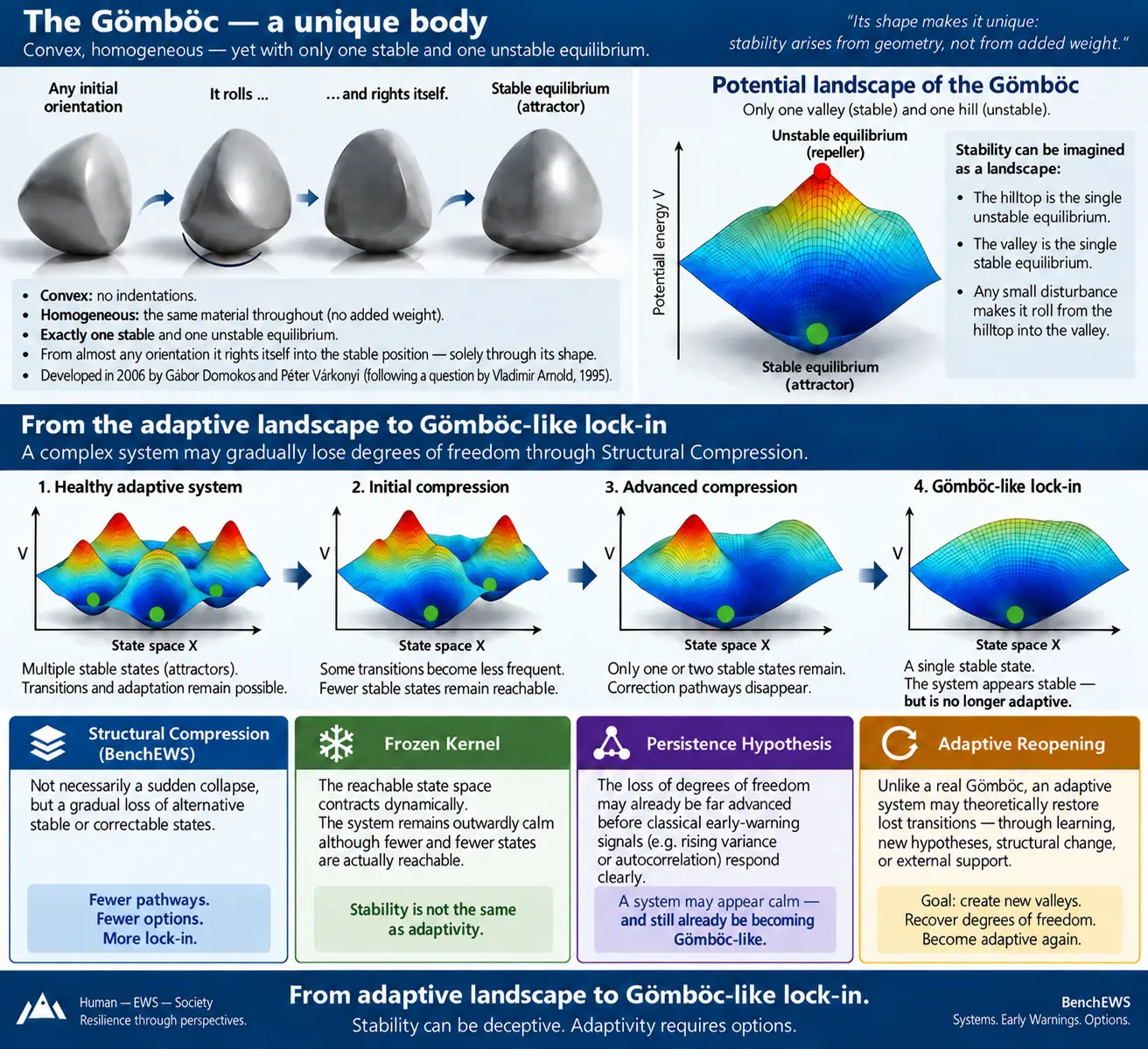
Software · Development status
Planned release: September 2026
Planning target · contingent on final release checksPlanned for mid-2027
Development horizon · next stage of evidence-based system diagnostics02 / Choose your perspective
Formalization, DOI sources, falsification criteria, evidence status, and validation.
Review mathematics and publications →02Software, indicators, test data, simulation, and reproducible systems analysis.
Open software and simulation →03Early warning, feedback loss, robustness, governance, and system blindness.
Open the decision-maker path →03 / Scientific status
BenchEWS distinguishes implemented capabilities, validated cases, proposed methods, and falsifiable hypotheses. Publication does not imply validation or universal validity.
Published and citable; not automatically empirically validated.
Follows within explicitly stated model assumptions.
Tested in simulations or methodological reference cases.
Tested with real data; the validity domain remains explicit.
A falsifiable claim whose confirmation remains open.
Planned research or software; not yet implemented.
Further theoretical exploration; not additional empirical evidence.
00 / Orientation
Once the problem is clear, continue with the definition, evidence, or software.
Problem, guiding question, terminology, and explicitly stated boundaries.
→02 · SCRUTINISEEvidence matrix, maturity levels, falsification, validation, and open gaps.
→03 · APPLYImplemented capabilities, documented platforms, and the separate roadmap.
→00A / Recent Research · Status September 9, 2026
A new positioning study locates the shared guiding question relative to established research fields, while two theoretical frameworks examine it at network and individual scales. All three are designed to be falsifiable but are not empirically validated or implemented as Studio capabilities.
Comparative positioning, a non-scalar O/F/D/R/V profile, and explicit falsification conditions.
Open paper and evidence boundaries →06 SEP 2026 · INDIVIDUAL ADAPTIVE SYSTEMSAdaptive evidence integration, prediction-error persistence, estimator latency, and hard falsification criteria.
Open published research →05 SEP 2026 · NETWORKED INFORMATION SYSTEMSEpistemic quality, visibility, propagation, lock-in, and candidate reopening of correction pathways.
Open hypothesis framework ↗Status rule: Published paper ≠ empirical validation ≠ implemented Studio 3.0 capability.
00B / Canonical research target
BenchEWS investigates whether declining observation, feedback, degrees of freedom, responsiveness, and validation can be detected before visible system failure—and under which conditions correction pathways may reopen.
Status: Falsifiable research program; not a universal causal chain or a validated diagnostic instrument.
Explore the research target and measurement architecture →00A / Research roadmap
The roadmap begins with the citable Studio 1.4.0 release and clearly separates it from current release preparation, planned capabilities, and open research horizons.
00A / Visual abstract
The ECHO chain separates observation, feedback, response and validation. Every transition can fail and must therefore be examined separately.
DDataBounded observationFCQFeedback qualityIs the signal reliable?RF(T)System responseHow does the system respond over time?TRTransition responseAre correction paths changing?VValidationDoes the claim survive counter-models?Status clarity: variance and lag-1 autocorrelation are executable in Studio 1.4.0. CRTI is scientifically described and part of a manuscript under review, but is not yet an executable module of the released Frozen Kernel.
05 / Intuitive mechanism
Choose a scenario or move the slider yourself from chaos through the stability corridor to rigidity. The model shows how both under-order and over-order weaken self-correction—while conventional indicators often recognize over-order only late.
Within the BenchEWS research programme, this process chain is referred to as the Mallinckrodt Cycle.
Mallinckrodt cycle: a conceptual model of order—not a forecast or an empirically established law.
Tap step 1 first and then step 2. Compare how visible stability and available correction paths change.
02A / From metrology to practice
As additional rules and central interventions close local alternatives: does fault-correction capacity deteriorate before availability or latency visibly shifts?
What happens when rules reward not only victory and defeat, but risky cooperation, pattern formation and preserved correction paths?
Open case study →These scenarios illustrate the assessment logic. They are neither field validation nor a claim of universal deployment readiness.
03 / Start here
01 / Definition
BenchEWS (Benchmarking Early Warning Systems) develops a reproducible, cross-domain environment in which indicators, models, and diagnostic chains are compared under explicit assumptions, uncertainties, and validity domains. The program investigates whether, and under which conditions, measurable changes in observation, structure, or dynamics precede a loss of self-correction.
Under which conditions do complex systems lose self-correction?
Technical, ecological, organizational, institutional, societal, individual, economic, financial, and networked systems—through explicitly identified adapters and validation cases, not through a universal explanatory claim.
01A / Scientific position
BenchEWS studies nonlinear complex systems using mathematical tools for dynamics, stability, bifurcation, feedback, and structural change. It begins with explicit assumptions and testable data—not with a party, ideology, or preferred political direction.
The same definitions, measurement rules, and falsification criteria apply regardless of who benefits politically from a result or who finds it inconvenient.
Complex reality requires multiple independent perspectives and counter-indicators. Binary models discard information, alternatives, and paths to correction.
Mathematics can provide a shared and testable basis for understanding. The goals a society chooses remain democratic and normative decisions.
Performance, participation, and distribution can be examined as coupled system conditions. BenchEWS does not prescribe their political balance; it makes feedback and blind spots testable.
Mathematics replaces neither education nor democracy. It can serve as a reliable compass when assumptions are visible, uncertainty is reported, and every result remains open to refutation.
02 / Boundaries
These boundaries are part of the scientific statement—not a footnote.
BenchEWS does not predict the timing or occurrence of a tipping point with certainty.
The program provides no general number for how much ‘pressure’ any arbitrary system can withstand.
Agent-based models and machine learning are possible modules, not mandatory or universally implemented components.
A plausible field of use is not evidence of empirical effectiveness.
If data, identifiability, or validity are insufficient, the diagnostic claim must be withheld.
03 / Architecture
Technical availability remains explicitly separate from scientific evidence status.
Software capability exists in the specified development state
Capability is usable in a released version
Capability has not yet been released
An open issue prevents release
Future capability; not yet available
The ECHO/SCD semantics D → FCQ → RF(T) → TR → V ↺ form a specified diagnostic architecture; they must not be read retroactively as validated properties of all earlier modules.
04 / Sources
If accounts conflict, prefer the latest source explicitly designated as canonical and versioned—not a summary inferred from general-domain literature.
Eight evidence-disciplined pathways through the research programme
10.5281/zenodo.22726646↗02Programme positioning, non-scalar O/F/D/R/V profile, and explicit evidence boundaries
10.5281/zenodo.22669876↗03Adaptive evidence integration, prediction-error persistence, and falsifiability
10.5281/zenodo.22477244↗04Network propagation, epistemic quality, lock-in, and candidate reopening
10.5281/zenodo.22343273↗05Metrological assessment of self-correction
10.5281/zenodo.21917450↗06Recommended introduction
10.5281/zenodo.21724459↗07Programme structure and relationships
10.5281/zenodo.21398929↗08Comparative early-warning assessment
10.5281/zenodo.21207501↗09Hypothesis-level contribution
10.5281/zenodo.21628885↗10Released software and documentation
10.5281/zenodo.21807143↗05 / Scientific Resonance Observatory
The public Observatory records verified external sources, citations, substantive reflections and applications on a transparent level scale.
Open the public Observatory →06 / Origins · 2017 philosophical entrée
Panta Rhei, Plato's cave and the question of self-correction opened the conceptual space. What followed was not a computational system derived from philosophy, but a demand for an independent, falsifiable mathematical metrology.
Open the consolidated origin story →07 / Ask BenchEWS
The source-bound knowledge navigator may already help—without invented answers and with a direct path to primary sources.
08 / Provenance
Dipl.-Ing. Bernd von Mallinckrodt · independent research program · ORCID 0009-0005-5279-6607
08 / Qualified feedback
Are you testing a related hypothesis, working with early-warning signals, or seeking to challenge BenchEWS methodologically? Let us compare assumptions, data and kill tests.
Request scientific exchange →