OBJECT · DRIFT · Phi
Reported implemented and synthetically tested research components; no integrated 3.0 release or empirical validation. Phi is PC1 explained-variance ratio, not a universal tipping-point detector.
Research architecture · canonical development archive
A public research-to-software archive: every planned module is connected to its scientific basis, epistemic boundaries, implementation status, and later verification evidence.
SCF / 2026
Planned Studio 3.0 work on selective reporting, receiver models and robustness of early-warning signals. Specification only; no implementation or empirical validation is claimed.
Open SCF requirements and project plan →27 OCT 2026 · NEW DEVELOPMENT OUTLOOK
An early design study compares the current indicator-oriented Studio 2.0 workflow with a possible modular ECHO interface. The image is not a software screenshot; all representations are illustrative.
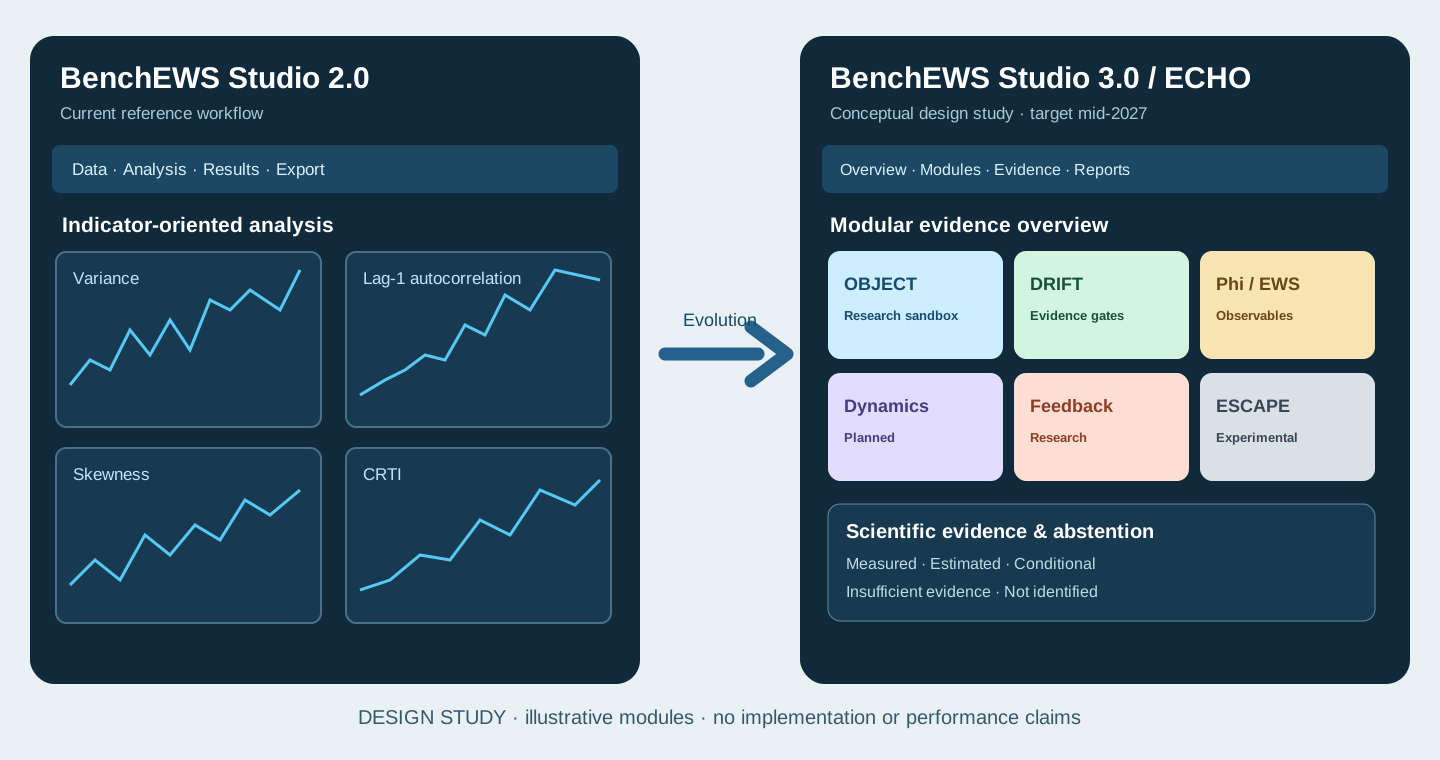
What changes? The familiar analysis workflow remains a reference, while OBJECT, DRIFT, structural observables, evidence gates and experimental research could be presented through a clearer modular interface.
27 OCT 2026 · REQUIREMENTS CONSOLIDATION V0.1
A provisional inventory currently contains 37 entries, including scientific methods, infrastructure capabilities and research ideas. This is not a count of implemented product modules. The original sources and overlaps are being audited.
Reported implemented and synthetically tested research components; no integrated 3.0 release or empirical validation. Phi is PC1 explained-variance ratio, not a universal tipping-point detector.
Directed dynamics, temporal trends, recovery, viability and observation limits require independent implementation and validation.
Epistemic self-correction, collective world models, text-derived priors and feedback integrity are research candidates, not available Studio 3.0 functions.
Typed presentation contracts and historical contract tests exist; the integrated UI, export parity, empirical experiments and release gates remain incomplete.
Development rule: Paper → requirements → implementation → tests → empirical validation → explicit release authorization. A concept paper is not an implemented feature.
Roadmap target: mid-2027, conditional on evidence and engineering readiness.
01 / Purpose
BenchEWS Studio 3.0 ECHO is the planned next diagnostic architecture of the BenchEWS Research Programme. This page is its canonical public archive. It deliberately distinguishes published theory, specification, prototype, implementation, and release.
Status vocabulary: Research → Specification → Prototype → Implemented → Released. A publication never implies that the corresponding software capability already exists.
02 / ECHO MODULE MAP
Disturbance–Recovery Inference & Fidelity Test. Metrological gate that checks whether passive structural or spectral signals may support mechanistic disturbance–recovery inference.
DRIFT-M · Matching evidence
DRIFT-O · Observability / identifiability
DRIFT-R · Reliability / robustness bounds
DRIFT-I · Invariance
DRIFT-N · Nonstationarity
DRIFT is retained as a metrological control concept. Its component mathematics is established and is not claimed as new BenchEWS mathematics.
Open current DRIFT record ↗The broader ECHO chain and additional modules remain research/specification targets until their mathematical definitions, bindings, tests, provenance, and status are individually documented.
D → FCQ → RF(T) → TR → V ↺
03 / Research-to-software traceability
For DRIFT, theorem-level claims and non-claims are translated into stable software requirements and acceptance tests. Future development must preserve this chain rather than re-interpreting the science ad hoc.
| Research object | Software consequence | Current status |
|---|---|---|
| Φ / spectral compression | Structural signal only; never label resilience from Φ alone. | SPECIFIED |
| DRIFT-M | Expose whether matching assumptions are independently justified or unresolved. | SPECIFIED |
| DRIFT-O | Report information loss and non-identifiability under partial observation. | SPECIFIED |
| DRIFT-R | Report robustness bounds when their required quantities are available. | SPECIFIED |
| DRIFT-I / N | Gate interpretation when coordinate invariance or local stationarity is not justified. | RESEARCH / SPECIFICATION |
04 / Publication & design archive
Structural, observational, and statistical identifiability limits of passive covariance. Mathematical basis of the DRIFT metrology module.
Concept DOI 10.5281/zenodo.22836388 ↗Concept DOIs are preferred for persistent links to evolving Zenodo records. Version DOIs remain visible for reproducibility. Future module papers and implementation milestones will be added here with their software role and status.
05 / Research decision · 20 September 2026
During development of BenchEWS Studio 3.0 / ECHO, a candidate Adaptive Coverage concept was subjected to successive adversarial mathematical gates. The proposed scalar Adaptive Coverage Index (ACI), and the later claim that Compression, Recovery and Task-Constrained Response Geometry form a novel three-axis theory, were not retained. Substantial parts are already covered by established controllability, robust-control, principal-angle and viability theory.
| Candidate | Status | Consequence |
|---|---|---|
| Adaptive Coverage Index (ACI) | REJECTED | No new BenchEWS scalar metric claimed. |
| C / R / G joint novelty | REJECTED | No new three-axis theory claimed. |
| Control & viability mathematics | REFERENCE | May be used as established diagnostic mathematics with attribution. |
| DRIFT | RESEARCH / SPECIFICATION | Retained as a metrological control layer for interpretation gates; no novelty claim for its established component mathematics. |
| Individual branch | EXPLORATORY | No clinical or psychiatric interpretation; no framework paper from the rejected C/R/G core. |
What is BenchEWS development here? The documented contribution is the research process, the tested hypothesis, its rejection/reformulation, and the resulting ECHO/DRIFT architecture decision — not ownership of the established mathematics used in the audit.
06 / Development log
Adaptive Coverage research branch frozen after mathematical red-team review: ACI rejected; C/R/G novelty rejected; established control and viability diagnostics retained as reference mathematics; DRIFT retained as a metrological control concept; Individual remains exploratory.
Scientific boundary: This archive documents intent, evidence and rejected hypotheses. It does not turn planned architecture into implemented or validated software.